
Fill out the form now to receive a comprehensive guide to Process of Real Estate Purchase
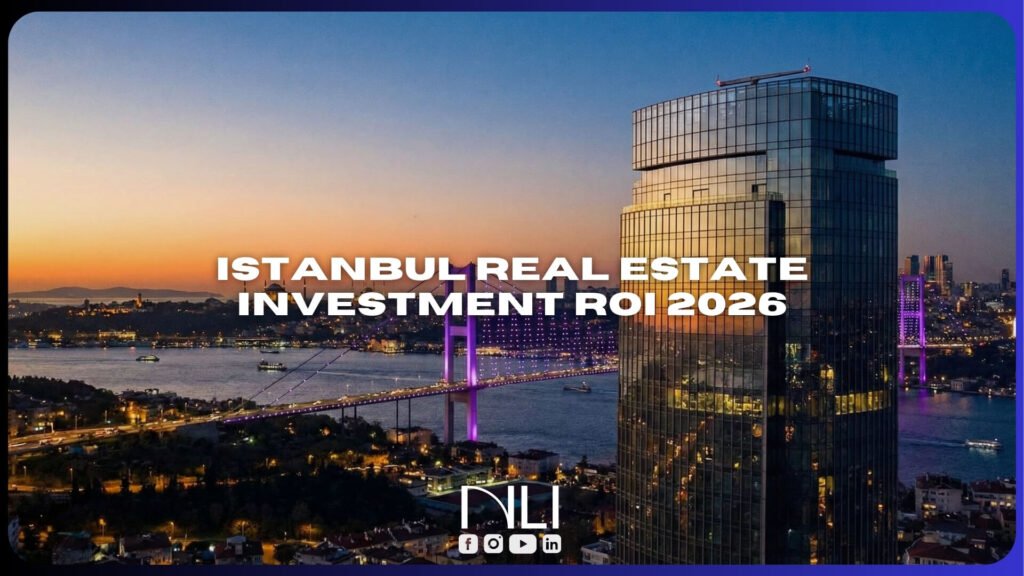
Istanbul Real Estate Investment ROI 2026
As we navigate the first half of 2026, the Istanbul real estate sector has undergone a fundamental transition. The era of high-volatility speculative gains has been replaced by a period of sustainable maturity. For the institutional investor and high-net-worth individual (HNWI), the 2026 market offers something far more valuable than a simple price rally: predictability, legal transparency, and infrastructure-backed value.
At NLI, we view Istanbul not merely as a residential market, but as a strategic asset class. With the full operational integration of the Istanbul International Finance Center (IIFC) and the stabilization of the regulatory environment, the “Smart Growth” phase is now in full effect.
The Macroeconomic Landscape: Stability as a Catalyst
In 2026, the Turkish Central Bank’s commitment to inflation-targeting has begun to yield a more balanced domestic economy. While nominal prices in Turkish Lira (TRY) continue to adjust (projected at 25–35% for 2026), the luxury and investment-grade segments remain fundamentally pegged to USD and EUR valuations.
For the international investor, this creates a “Currency-Smart Entry” point. As the cost of new construction remains high due to global commodity prices, existing “New-Build” stock (completed 2023–2025) represents a significant value opportunity where replacement cost exceeds current market pricing.
The IIFC Factor: Ataşehir as the New Regional Alpha
The most significant driver of Istanbul real estate investment ROI in 2026 is the Istanbul International Finance Center (IIFC) in Ataşehir. Now hosting over 50,000 finance professionals daily, the IIFC has fundamentally shifted the city’s gravitational center.
Impact on Rental Yields and Occupancy
- Executive Demand: There is a critical shortage of Grade-A residential units within a 5km radius of the IIFC.
- Yield Compression vs. Growth: While yields in older districts hover around 4%, investment-grade 1+1 and 2+1 units in Ataşehir and Ümraniye are yielding 6.5% to 8% in 2026, driven by corporate housing contracts.
- The M12 Link: The completion of the M12 Göztepe-Ümraniye Metro line has connected the finance hub to the high-end residential pockets of the Asian side, ensuring long-term liquidity for assets in this corridor.
2026 Regulatory Precision: Citizenship & Valuation
The Turkish Citizenship by Investment (CBI) program remains the primary vehicle for global mobility in 2026. However, the “institutionalization” of the process is where NLI provides its core value.
The GEDAŞ & Digital Appraisal Standard
The 2026 regulatory framework has eliminated the “valuation gap” that previously plagued the market. All properties must now undergo a rigorous digital appraisal through the GEDAŞ system.
- Minimum Threshold: The investment requirement remains fixed at $400,000.
- Rayiç Bedel Compliance: It is no longer possible to declare a lower value at the Title Deed Office than the actual transaction price. For HNWIs, this ensures that their path to citizenship is legally bulletproof and fully compliant with international anti-money laundering (AML) standards.
- The 3-Year Hold Strategy: Data from 2025 shows that investors who held assets for the mandatory 36-month period saw an average capital appreciation of 18–22% in USD terms, significantly outperforming traditional emerging market indices.
The “Safety Premium”: Earthquake Resilience as a Value Driver
In 2026, the market has bifurcated. There is now a distinct “Safety Premium” attached to earthquake-resilient, modern projects. Institutional capital is exclusively flowing into “Site” style developments built after 2019, which utilize high-grade C35/C40 concrete and raft foundations.
Properties in districts like Kağıthane and Zeytinburnu, which have undergone massive urban transformation, are commanding a 15–20% premium over older stock in neighboring historic zones. At NLI, we prioritize these “New-Era” developments, as they offer the highest resale liquidity—local Turkish buyers are now equally prioritized on safety, ensuring a robust exit strategy for the foreign investor.
Strategic Districts for 2026 Allocation
1. The European Business Nexus: Kağıthane & Bomonti
These districts have completed their evolution into the “New Central Business District.” With the M7 Metro and M11 Airport Link fully operational, Kağıthane has become the primary choice for “Buy-to-Let” portfolios targeting the city’s growing tech and creative class.
2. The Coastal Modernist Strip: Zeytinburnu to Bakırköy
The “Blue Route” offers the rare combination of sea-front luxury and high-speed transit (Marmaray). In 2026, Zeytinburnu is no longer an industrial frontier; it is a refined residential belt where capital preservation is the primary objective.
3. The Asian Growth Corridor: Kartal & Pendik
As Ataşehir reaches price saturation, institutional “Growth Capital” is moving southeast. The M4 Metro extension and the expansion of Sabiha Gökçen Airport have made Kartal the top contender for 2026 capital appreciation, with nominal growth projected at 45% by year-end.
Fiscal Advantages: VAT Exemption & Capital Gains
The 2026 fiscal environment remains highly favorable for first-time foreign buyers. Under Article 13/1-i of the VAT Law, eligible international investors can still benefit from a 0% VAT (KDV) rate, provided the purchase is made in foreign currency and the property is held for at least one year.
Furthermore, the 5-Year Capital Gains Tax Exemption remains a cornerstone of the Turkish market. Investors who view Istanbul as a mid-term (5+ year) play can exit their positions with zero tax liability on their appreciation, a fiscal incentive rarely matched in Western Europe or North America.
The Istanbul market in 2026 is a market for the informed professional. The days of “accidental gains” are over; success now requires a data-driven approach focusing on transit-proximate, earthquake-compliant assets within the IIFC’s sphere of influence.
Istanbul remains the ultimate transcontinental hedge—a city where your capital is secured by physical infrastructure and global-standard legal frameworks.

Last Viewed
Contact NLIFree Expert Consultation
Interested in this property? Talk to Our Istanbul Experts
⚠️ Our team will get back to you within 2 hours with pricing, availability and similar options tailored to your budget. Property details are subject to change without notice.
🔒 Your information is safe. We never share your data with third parties.
Discover the Market
Istanbul Neighborhoods
Find your dream home
- European Side
- All European Side Popular
- Sisli
- Beyoglu
- Campaigns Europe New
- Asian Side
- All Asian Side
- Uskudar
- Kadikoy
Most Popular Filters
Quick search
- By Budget
- Affordable
- $250K – $500K
- Luxurious Apartments
- By Type
- Ready to Move Hot
- 2 Bedroom
- 3+ Bedroom
Information Center
FAQ – Guides – About
- FAQ
- FAQ – Property Purchase
- Guides
- Market Analysis
- District Guides
- Explore NLI
- Turkish Citizenship
- Residency Permit
- About NLI
European Side
Asian Side
By Budget
By Type
FAQ
Guides
Explore NLI
Istanbul Real Estate
Start your search
By location
By investment